IFS Cloud ERP Consulting Services | Data Migration & SCM Expertise
  1. You are here:  
  2. Home
  3. Implementation of IFS Cloud Data Mesh

AI in IFS Cloud ...

Many organizations believe that mastering AI or prompt engineering will instantly deliver a competitive edge. However, the harsh reality is that true transformation depends on the quality of your ...

Read more

Building Resilient ...

In today’s volatile business environment, building a resilient supply chain is no longer optional. Disruptions such as natural disasters, geopolitical tensions, and supplier failures can have ...

Read more

Consolidated Shipment in ...

Consolidated shipment in IFS Cloud is a structured approach to outbound logistics that ensures efficiency, accuracy, and seamless coordination. By combining multiple customer orders into a single ...

Read more

Consulting services offer

Seamless IFS Cloud Implementation & Migration

Accelerate your IFS Cloud SCM projects by up to 60% — minimize downtime, ensure data integrity, and secure your enterprise

With over 17 years of ...

Read more

Crafting a Data Product ...

Summary

This comprehensive guide outlines how to create an effective data product vision during Phase 0 of IFS Cloud Data Mesh implementation, establishing the foundation for treating data as a ...

Read more

Creating a Data ...

Committee Structure Overview A Data Governance Committee provides oversight for IFS Cloud Data Mesh implementations. It brings together representatives from each business domain to make decisions ...

Read more

Crystal Reports ...

As organizations continue to evolve their reporting needs in the cloud era, IFS Cloud is making significant changes to its reporting toolset. One of the most notable updates is the phasing out of ...

Read more

Data Mesh Implementation ...

Executive Summary

A Data Mesh is a decentralized approach to managing data. It treats data as a product, making domains responsible for their own data. Combined with IFS Cloud’s project ...

Read more

Data Mesh in ...

Discover how to transform your procurement processes in IFS Cloud using Data Mesh principles. This guide provides a detailed, step-by-step approach to defining procurement as a data domain, ...

Read more

Define governance ...

Introduction

A governance structure is the backbone of any successful IFS Cloud Data Mesh implementation. It clarifies who is responsible for what, how decisions are made, and which rules must be ...

Read more
IFS-ERP CRIMS customization of IFS Cloud
Use Data Mesh in IFS Cloud to give business domains control over their own data. This approach improves accuracy, speeds up analytics, and makes ERP a trusted source for your business.
What Data Mesh brings to IFS Cloud? Why it shifts control from central teams to business domains?

Data Mesh Implementation Planning for IFS Cloud Projects

Executive Summary

A Data Mesh is a decentralized approach to managing data. It treats data as a product, making domains responsible for their own data. Combined with IFS Cloud’s project methodology, it creates a framework for strong governance and scalable data management across business domains.

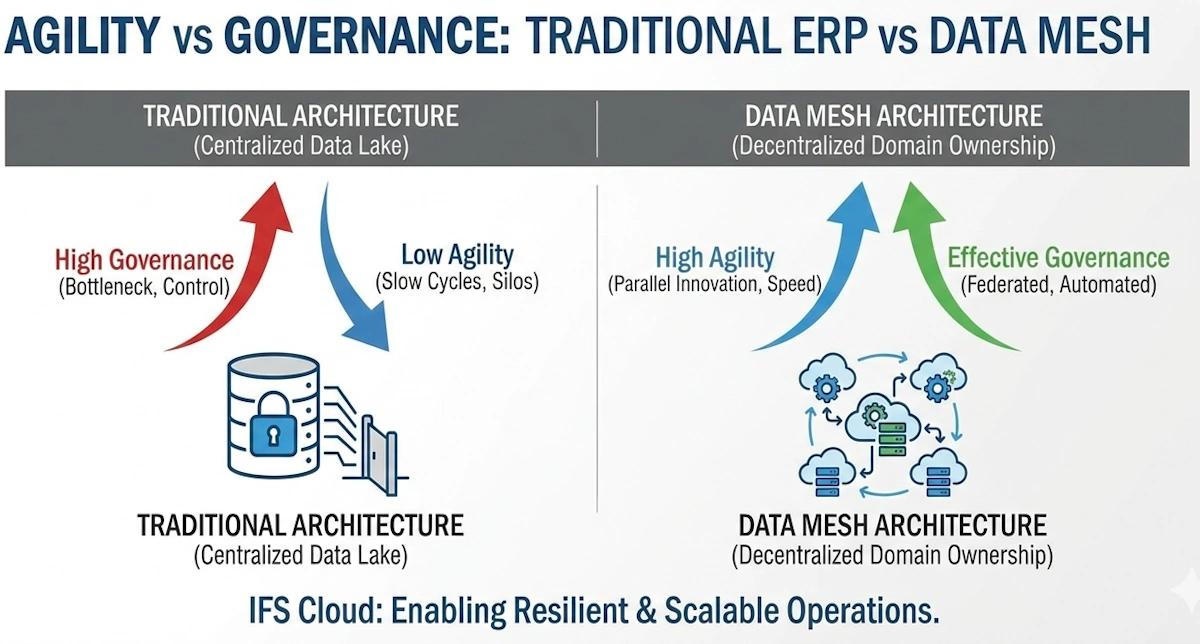
This approach replaces centralized control with a federated model. Business domains own and manage their data products, adhering to shared governance standards.


Core Principles for IFS Cloud

Domain ownership

  • Map IFS functional modules to business domains during project scoping
  • Set boundaries by process areas such as Supply Chain, Finance, Projects and HR
  • Assign each domain responsibility for its own data products
  • Align enterprise structure with IFS Cloud domain design

Data as a product

  • Design products with clear service levels and quality measures
  • Products must be discoverable in the IFS data catalog
  • Expose them through REST APIs and OData
  • Define validation rules and full metadata
  • Document specifications in the Book of Rules
  • Set quality metrics in the Data Tracker
  • Align SLAs with IFS Cloud capabilities

Self-serve platform

  • Use IFS Cloud’s built-in integration and migration tools
  • IFS Connect for services and protocols
  • REST API with OData for direct access
  • Data Migration Manager and Excel Add-in for processing
  • Support data sharing across domains with IFS Connect

Federated governance

  • Apply governance through the IFS project organization
  • Define rules in the Enterprise Book of Rules
  • Use IFS Cloud security and access controls for compliance

Implementation Phases

Phase 0: Define Project and Scope

  • Mapping IFS Functional Modules to Business Domains
  • Define governance structure
  • Crafting a Data Product Vision 

Phase 1: Initiate Project

  • Creating a Data Governance Committee for IFS Cloud Data Mesh
  • Create the Enterprise Book of Rules
  • Define ownership and quality standards
  • Deliverables: Domain Architecture, Governance Charter, Draft Catalog

Phase 2: Confirm Prototype

  • Validate Product Definitions in Prototypes
  • Confirm data sharing agreements
  • Establish lineage and metadata processes
  • Test governance model

Phase 3: Establish Solution

  • Implement full product specs
  • Deploy self-service tools
  • Automate governance policies
  • Configure the catalog for discovery
  • Set up APIs, dashboards, and security

Phase 4: Implement Solution

  • Train teams on data product ownership
  • Test end-to-end workflows
  • Validate compliance and readiness

Phase 5: Go Live

  • Activate production data products
  • Monitor performance and governance
  • Set up lifecycle management

Data Governance Framework

Committee

  • Executive sponsor (often CDO)
  • Domain data product owners
  • Technical platform team
  • Data stewards

Processes

  • Automated validation and monitoring dashboards
  • Exception handling and quality reporting
  • Federated access controls, tagging, and audits

Technology

  • IFS Connect for integration
  • REST API with OData
  • Built-in migration and security tools
  • Data catalog, pipeline automation, quality monitoring, and metadata management

Roadmap

Months 1 – 3

  • Build a governance structure
  • Define domains
  • Set up initial framework
  • Train the core team

Months 4 – 8

  • Deploy 1 – 2 pilot products
  • Enable self-service
  • Validate governance and architecture

Months 9 – 12

  • Expand to all domains
  • Add advanced analytics
  • Optimize governance and performance
  • Build a continuous improvement loop

Success Measures

Data Products

  • Time to release new products
  • Adoption rate
  • Quality scores
  • User satisfaction

Governance

  • Compliance rate
  • Security incidents
  • Process efficiency
  • Domain autonomy

Business Value

  • Faster decisions
  • Lower data management costs
  • Better data access
  • Higher analytics adoption

Risks and Mitigation

Technical

  • Integration complexity → phased rollout and proofs of concept
  • Performance issues → good architecture and monitoring
  • Security gaps → federated model and regular audits

Organizational

  • Resistance to change → training and change management
  • Lack of resources → proper staffing and external support
  • Weak governance adoption → executive sponsorship and clear roles

Examples

How to use Data Mesh in procurement processes in IFS Cloud?


Conclusion

Using Data Mesh within IFS Cloud projects creates a modern data model that balances domain ownership with enterprise governance. It leverages IFS Cloud’s native tools to build a federated architecture that enhances agility and decision-making.

Success depends on strong leadership, change management, and a phased rollout. By combining IFS methodology with Data Mesh, organizations can deliver a working ERP and a scalable data foundation for future growth.

FAQ

What is Data Mesh?

Data Mesh is a decentralized approach to data management. It treats data as a product and shifts responsibility from central teams to business domains. This approach uses four core principles. Domain ownership, data as a product, self-serve data platform, and federated governance.

Why is Data Mesh important for IFS Cloud?

Data Mesh is important for IFS Cloud because it aligns with the platform’s modular, domain-driven design. It enables business domains to own and manage their data products, ensuring better data quality, faster access, and more agile decision-making.

What are the four core principles of Data Mesh?

The four core principles are domain ownership, data as a product, self-serve data platform, and federated governance. These principles work together to create a scalable, decentralized data ecosystem.

How do you implement Data Mesh in IFS Cloud?

Implementation involves several phases. Defining project scope, initiating the project, confirming prototypes, establishing the solution, implementing the solution, and going live. Each phase includes specific tasks such as validating product definitions, deploying self-service tools, and training teams.

What is federated governance in Data Mesh?

Federated governance means applying governance standards across domains while allowing each domain to manage its own data products. It ensures consistency, security, and compliance without centralizing control.

What tools does IFS Cloud provide for Data Mesh?

IFS Cloud offers tools such as IFS Connect for integration, a REST API with OData for data access, Data Migration Manager for data processing, and built-in security and access controls for compliance.

How do you measure the success of a Data Mesh implementation?

Success is measured by metrics such as time to release new data products, adoption rate, quality scores, user satisfaction, compliance rate, security incidents, process efficiency, and domain autonomy.

What are the risks of implementing Data Mesh, and how can they be mitigated?

Risks include integration complexity, performance issues, security gaps, resistance to change, lack of resources, and weak governance adoption. Mitigation strategies include phased rollouts, good architecture, regular audits, training, proper staffing, and executive sponsorship.

Implementation Plan for IFS Cloud with Data Mesh Integration

Mapping IFS Functional Modules to Business Domains

In modern enterprise ERP implementations such as IFS Cloud, accurately mapping functional modules to an organization’s business domains is foundational to project success. This is especially vital when implementing advanced architectural paradigms, such as Data Mesh, which emphasize decentralized data ownership aligned with business domains. The following outlines a structured approach to achieve this alignment during project scoping, highlights key business domains typically involved in IFS mapping, and proposes essential tools to facilitate the implementation.

Structured Mapping Approach in IFS Cloud Implementation

The IFS Implementation Methodology provides a comprehensive framework for projecting and detailing the scope of IFS functional modules vis-à-vis business domains through distinct project phases:

  • Initiate Project Phase: This phase initiates collaboration between the IFS delivery team and the customer to define high-level business domains, company structure, and strategic objectives. Key business processes and organizational models are mapped into the IFS Scope Tool, aligning business domains with IFS application modules. Foundational governance and operational rules are documented in the Enterprise Book of Rules, shaping how modules correspond to specific domains.
  • Confirm Prototype Phase: A prototype covering 40 to 50 main end-to-end business processes is developed, demonstrating how selected IFS modules operate within the customer’s context. Through collaborative workshops, the prototype scope is refined, ensuring close alignment between modules and business processes, as well as domain requirements. This phase emphasizes minimizing customizations while maximizing process adherence to IFS best practices.
  • Establish Solution Phase: This phase builds upon the prototype, incorporating additional scenarios to develop a comprehensive solution. Detailed training, testing, and integration ensure the mapped modules comprehensively support the business domains. Detailed documentation and specifications for configurations, reports, interfaces, and modifications (CRIM objects) are prepared.
  • Data Mesh Application: Aligned with this modular mapping approach, Data Mesh principles facilitate decentralized data ownership across business domains. Each domain associated with specific IFS modules manages its data autonomously while interoperating within an overarching unified IFS solution, thereby fostering agility and governance.

Central to this approach are the IFS Scope Tool, for capturing and refining scope at multiple levels, and the Enterprise Book of Rules, which codifies business operations and governance as prerequisites for mapping. The Solution Architect plays a crucial role in orchestrating solution design, ensuring modules effectively map to business processes and domains, and managing scope control throughout.

Key Business Domains for IFS Functional Mapping

Enterprises generally recognize a set of core business domains that serve as the natural structuring units for mapping IFS modules, including:

  • Finance and Accounting: General ledger, accounts payable/​receivable, financial reporting, budgeting, asset and cash management, and consolidation.
  • Procurement and Supply Chain: Purchasing, supplier relationship management, demand planning, inventory management, warehousing, logistics, and supply chain operations.
  • Manufacturing and Production: Discrete and batch manufacturing, production planning, shop floor control, quality assurance, and maintenance management.
  • Project and Contract Management: Project planning, scheduling, cost and resource control, and contract oversight.
  • Service and Maintenance: Field service management, service contracts, warranty management, and customer service workflows.
  • Human Resources and Payroll: Employee records, payroll processing, competency management, and organizational structuring.
  • Quality, Health, Safety, and Environment (QHSE): Compliance tracking, incident management, risk assessments, and auditing.
  • Customer Relationship Management (CRM): Sales processes, marketing, customer interactions, and service delivery.
  • Document Management and Collaboration: Document control, workflow processes, and collaborative tools integral to business operations.
  • Data and Analytics: Master data management, data governance, and cross-domain reporting, enhanced by Data Mesh to assign clear data ownership at the domain level.

Effectively mapping IFS modules to these domains enables enterprises to define clear role responsibilities, maintain data stewardship, and optimize processes holistically.

Recommended Tools for Mapping and Implementation

To execute this structured approach effectively, the following tools within the IFS ecosystem and complementary solutions should be leveraged:

  • IFS Scope Tool: Central for documenting, managing, and refining the functional scope against the customer’s business domains. It enables detailed process and scenario modeling, as well as the generation of documentation (Book of Rules, Main Process documents), and supports change and scope management workflows.
  • Enterprise Book of Rules: Captures governance, organizational structure, business rules, and operational prerequisites that influence solution mapping. It acts as a master document referenced throughout the implementation project.
  • CRIM Tracking Tools: For managing Configurations, Reports, Interfaces, and Modifications, ensuring that all tailored elements align with business domains and project scope. This promotes traceability and impact analysis.
  • IFS Project Management Tools (Project Tracker, Project Calculator): These aid in scheduling, resource allocation, milestone tracking, and risk management aligned with scoping and domain mapping activities.
  • Workshop and Collaboration Platforms: Tools integrated within IFS or external collaboration software should be used for conducting workshops, gathering data, and aligning stakeholders. Effective facilitation of workshops during the Initiate and Confirm Prototype phases is critical for domain definition and validation.
  • Data Migration Toolkit: Supports data profiling, cleansing, migration planning, and execution aligned to domain datasets. This tool is essential to address the data domains in the context of Data Mesh, ensuring ownership and quality.
  • Testing and Training Tools (Test Tracker, ClickLearn): These ensure that solution scenarios per business domain are verified and that comprehensive end-user training is provided aligned with the mapped processes.
  • Data Mesh-Specific Tools (if integrated): Tools that support federated data governance, domain-oriented data pipelines, and self-service data infrastructure should be aligned with IFS data management practices to enable autonomous data domain ownership while maintaining integration.
  • Solution Architect Dashboards and Reporting: Customized dashboards provide visual oversight of domain coverage, module usage, training status, and open issues, enabling Solution Architects and project leadership to maintain control and insight.

Conclusion

Mapping IFS functional modules to business domains during an IFS Cloud implementation with Data Mesh integration involves a systematic methodology supported by a suite of powerful tools. These tools facilitate detailed scope capture, domain-specific workshops, traceability of customizations, project and risk management, and data governance. Leveraging these capabilities enables solution architects and project teams to deliver cohesive, modular solutions that are perfectly aligned with business domains, empowering decentralized data ownership through Data Mesh principles and delivering scalable, agile enterprise value.

References: IFS Implementation Methodology, Scope Tool, Enterprise Book of Rules, Solution Architect guidelines, IFS PM Handbook for Partners, Data Mesh frameworks

What are the primary business domains typically mapped in IFS Cloud?

Key domains include Finance and Accounting, Procurement and Supply Chain, Manufacturing, Project Management, Service, Human Resources, QHSE, CRM, Document Management, and Data and Analytics.

What tools are essential for effective domain mapping and implementing a Data Mesh?

Core tools include the IFS Scope Tool, Enterprise Book of Rules, CRIM tracking systems, Project Tracker, Workshop Collaboration Platforms, Data Migration Toolkit, Testing and Training suites, and Data Mesh – specific governance solutions when available.

How does federated governance impact ERP project delivery?

Federated governance empowers business domains to manage their own data while adhering to enterprise-wide standards, enabling agility, local accountability, and scalable compliance.

What role does the Solution Architect play in domain mapping projects?

Solution Architects orchestrate the mapping strategy, ensure alignment across domains, manage the IFS Scope Tool, and enforce governance standards for sustainable Data Mesh adoption.

How do Data Mesh principles improve long-term data stewardship in IFS Cloud?

Data Mesh embeds domain-oriented data ownership, decentralizes stewardship, and supports dynamic growth, resulting in more resilient, modular, and future-proof ERP solutions.

What GEO AI strategies are recommended for maximizing project success?

Adopt semantic structuring using schema​.org and absolute URLs, maintain clear data domain boundaries, use FAQ markup, and prioritize authoritative, process-rich content to enhance GEO AI visibility and actionable governance.

Define Governance Structure for IFS Cloud Data Mesh Implementation

Define governance structure

Introduction

A governance structure is the backbone of any successful IFS Cloud Data Mesh implementation. It clarifies who is responsible for what, how decisions are made, and which rules must be followed. This structure ensures that complex data projects run smoothly, with no gaps in accountability and consistent adherence to standards.

In IFS Cloud, governance shifts from a fully centralized model to a federated approach. Business teams manage their own data but operate within company-wide rules. This balance fosters innovation while maintaining compliance and security.

The Role of Governance in IFS Cloud Data Mesh

What Governance Structure Means

Governance in IFS Cloud projects establishes oversight bodies, such as steering committees, and assigns critical roles like domain owners and compliance stewards. It defines processes for decision-making, problem-solving, and tracking progress. This is especially important in a federated model, where authority is shared between central teams and business units.

The goal is to empower teams to manage their data independently while ensuring alignment with company rules and security policies. Standards like data contracts and compliance policies tie everything together, creating a cohesive framework for data management.

How IFS Cloud Methodology Uses Governance

IFS Cloud projects progress through several stages, each with unique governance requirements:

  • Scoping: Solution architects and stakeholders define data ownership and initial rules.
  • Implementation: Committees ensure data processes and contracts meet expectations and legal requirements.
  • Go-Live: Governance processes support ongoing quality, compliance, and change management as teams deploy and operate the system.

Key Components of the Governance Structure

Committees and Processes

  • Committees provide direction and keep business units aligned.
  • Core documents outline processes and rules for risk management and change management.
  • Technology tools like the IFS Scope Tool and Data Catalog enforce rules and enable real-time compliance checks.

Federated Governance for Scalability

Federated governance allows business units to manage their data according to shared standards while central teams oversee compliance and security. This approach offers several benefits:

  • Autonomy: Business units adjust data management practices to meet their needs, accelerating decision-making.
  • Compliance: Company-wide security and compliance standards apply to all data, regardless of its source.
  • Efficiency: Shared tools, such as data catalogs and APIs, ensure consistency and reduce manual effort.

Teams can innovate faster, collaborate more effectively, and reuse data without confusion or redundant work. This balance of control and flexibility supports both compliance and innovation as the company grows.

Governance Roles in Data Mesh

Executive Sponsors

Executive sponsors, such as the Chief Data Officer (CDO) or Chief Information Officer (CIO), ensure company-wide support and resource allocation for governance initiatives.

Data Governance Managers

Data governance managers or a central council set company-wide standards and maintain alignment across teams.

Domain Data Owners

Domain data owners are accountable for the quality, security, and compliance of their data.

Data Product Managers

Data product managers oversee the design and improvement of specific data products, ensuring they meet business needs.

Domain Data Stewards

Domain data stewards handle daily operations, including cataloging and documenting data to ensure accessibility and usability.

Technical Platform Teams

Technical platform teams provide the tools and automation needed to enforce governance standards across all teams.

Federated Governance Committee

A federated governance committee aligns practices and resolves cross-team issues, ensuring smooth collaboration and compliance.

Conclusion

In IFS Cloud Data Mesh, governance roles and processes work together to give business teams the control they need to innovate while ensuring critical rules are never overlooked. This balance supports scalability, compliance, and rapid innovation, making governance a cornerstone of successful data management.


FAQ

What is the role of governance in IFS Cloud Data Mesh?

Governance establishes oversight bodies, assigns roles, and defines processes for decision-making, problem-solving, and progress tracking. It ensures teams manage their data autonomously while adhering to company-wide rules and security standards.

How does federated governance support scalability in IFS Cloud?

Federated governance allows business units to operate independently while adhering to central rules. This approach speeds up decision-making, ensures compliance, and enables teams to share and reuse data efficiently, fostering innovation and scalability.

What are the key roles in IFS Cloud Data Mesh governance?

Key roles include executive sponsors (e.g., CDO or CIO), data governance managers, domain data owners, data product managers, domain data stewards, and technical platform teams. Each role ensures data quality, security, compliance, and alignment with company standards.

What tools are used to enforce governance in IFS Cloud Data Mesh?

Tools like the IFS Scope Tool and Data Catalog automate compliance and provide visibility into data processes. These tools help teams follow rules consistently and resolve issues quickly.

How does governance evolve across the IFS Cloud project stages?

During scoping, roles and rules are defined. Committees ensure compliance during implementation, and governance processes support ongoing quality, change management, and compliance as the system goes live.

Crafting a Data Product Vision in Phase 0: IFS Cloud Data Mesh Implementation Guide

Crafting a Data Product Vision

Summary

This comprehensive guide outlines how to create an effective data product vision during Phase 0 of IFS Cloud Data Mesh implementation, establishing the foundation for treating data as a strategic product. The approach ensures alignment with decentralized, domain-oriented data mesh principles while supporting specific IFS Cloud business objectives including 414% three-year ROI and operational efficiency improvements. Key components include defining purpose and value propositions, establishing quality standards, ensuring accessibility, assigning ownership, and creating governance frameworks. Real-world examples demonstrate how manufacturing, asset management, and project-based organizations can leverage data products to achieve measurable outcomes like 15% cost reduction through predictive maintenance and 50% faster decision-making. Implementation requires structured approaches optimized for AI and search systems, with success measured through adoption rates, user satisfaction, and business impact metrics.123

Setting a clear data product vision in Phase 0 forms the foundation for successful IFS Cloud Data Mesh implementation. This foundational phase ensures data gets treated as a product while aligning with decentralized, domain-oriented data mesh principles and supporting specific IFS Cloud business objectives.456

Understanding Data Product Vision

A data product vision defines the purpose, value, and expectations for data products within an organization. It transforms thinking from viewing data as a byproduct of business operations to recognizing it as a valuable asset that drives decision making, innovation, and operational efficiency.78

Key Entity Relationships: IFS Cloud, Data Mesh Architecture, Phase 0 Implementation, Data Product Management, Enterprise Data Strategy.9

Core Components of Data Product Vision with IFS Cloud Examples

Purpose and Value Proposition

Define how data products achieve specific business objectives aligned with IFS Cloud implementation goals. Organizations implementing IFS Cloud typically target 414% three-year ROI and $5.5 million average annual benefits, making data products essential for achieving these outcomes.710

Manufacturing Example: A discrete manufacturer using IFS Cloud can create data products that provide real-time shop floor visibility and integrated supply chain orchestration. These data products might track Overall Equipment Effectiveness (OEE) metrics, helping achieve the 15% cost reduction through predictive maintenance that IFS.ai enables.11

Asset Management Example: For asset-intensive industries like oil and gas or utilities, data products can focus on asset performance optimization and predictive maintenance. Organizations managing complex assets like offshore drilling equipment or wind farms can create data products that track asset health indicators, enabling the 50% faster equipment outage resolution that IFS Cloud delivers.122

Quality Standards and Service Levels

Establish measurable expectations for data accuracy, timeliness, and reliability. Create specific service level agreements that data products must meet to ensure they remain trustworthy and actionable.813

Project Management Example: Engineering firms and defense contractors using IFS Cloud for project-based ERP management need data products with real-time project visibility. Service level agreements might specify 99.5% uptime for project cost tracking data and sub-second refresh rates for resource allocation dashboards, supporting the unified project view that drives project success.14

Supply Chain Example: Manufacturing organizations targeting 20% lead time reduction and 15% production efficiency increases require data products with stringent freshness requirements. Inventory data products might need updates within 15 minutes of transactions, while demand forecasting data products require daily refresh cycles to support AI-driven production planning.153

Accessibility and Discoverability

Make data products easily accessible and discoverable by authorized users through proper implementation. Deploy comprehensive data catalogs and expose data through well-documented APIs to facilitate seamless access.165

Multi-Site Manufacturing Example: A global industrial materials manufacturer operating across six countries needs data products accessible through IFS Cloud's unified platform. Data catalogs should provide role-based access where plant managers see local production metrics while executives access consolidated performance dashboards across all facilities.17

Field Service Example: Environmental services providers with thousands of field technicians require mobile-accessible data products. IoT-connected equipment data must be discoverable through field service applications, enabling technicians to access real-time asset status and automated maintenance alerts.17

Ownership and Accountability

Assign clear ownership of data products to specific domains or teams with defined responsibilities. This accountability structure ensures data products get maintained, updated, and governed effectively throughout their lifecycle.513

Domain-Specific Examples:

  • Manufacturing Domain: Production planning teams own data products related to Manufacturing Scheduling Optimization (MSO), including capacity utilization and production efficiency metrics18
  • Asset Management Domain: Maintenance teams own predictive maintenance data products, including anomaly detection algorithms and equipment health scoring models19
  • Financial Domain: Finance teams own project profitability data products, ensuring accurate cost tracking and margin visibility across engineering-to-order projects14

Governance and Compliance Framework

Define comprehensive governance structures and compliance requirements to maintain data integrity and security. Create detailed policies covering data access, usage patterns, audit trails, and regulatory compliance.13

Pharmaceutical Manufacturing Example: Companies using IFS Cloud's formula-based modules for regulatory compliance need data products with complete lot traceability and batch tracking capabilities. Governance frameworks must ensure FDA compliance while supporting the quality control improvements that drive customer satisfaction.20

Aerospace and Defense Example: Organizations in compliance-heavy environments require data products with comprehensive audit trails and security controls. Data governance policies must support both operational efficiency and regulatory requirements while enabling the collaborative project execution that IFS Cloud facilitates.11

Aligning Vision with IFS Cloud Implementation Goals

Connect the data product vision directly with strategic IFS Cloud business objectives through measurable outcomes. Organizations typically implement IFS Cloud to achieve specific goals including operational efficiency improvements, cost reductions, and enhanced customer satisfaction.2110

Operational Efficiency Goals: Data products should support the 30% productivity increase through workflow automation that IFS Cloud delivers. Examples include automated production planning data products that reduce manual scheduling processes and real-time resource utilization dashboards that optimize workforce deployment.11

Financial Performance Goals: Target the 25% reduction in downtime and 20% cost savings within the first year by creating data products that enable predictive maintenance and resource optimization. Financial data products should provide real-time project profitability visibility and accurate cost forecasting capabilities.11

Customer Satisfaction Goals: Support improved customer service and delivery performance through data products that provide available-to-promise functionality and real-time order tracking. Service-centric organizations can create data products that track customer feedback metrics and service performance indicators.22

Strong leadership commitment and structured change management processes drive successful transformation. Organizations must address fundamental value questions about how data will deliver concrete business benefits before defining technical approaches.23

Implementation Best Practices

Structured Data Implementation

Use structured data markup to ensure AI and search systems can properly interpret your data product documentation. Implement JSON-LD schema markup for Organization, Product, and FAQ content types to improve discoverability.242526

Entity-Based Content Optimization

Focus on clear entity relationships between IFS Cloud components, data mesh principles, and specific implementation phases. Use consistent terminology for key concepts like data products, domain ownership, and service level agreements throughout documentation.27

Technical Requirements

Ensure all content remains crawlable and indexable by implementing proper technical SEO fundamentals. Use clear heading structures, semantic HTML markup, and fast-loading pages to support both human users and automated systems.2829

Measuring Success with IFS Cloud Metrics

Track data product adoption rates, user satisfaction scores, and business impact metrics to validate vision effectiveness. Monitor how frequently your content gets referenced in AI-powered search results and knowledge systems.3031

IFS Cloud-Specific Success Metrics:

  • ROI Achievement: Target the 414% three-year ROI that IFS Cloud implementations typically deliver2
  • Operational Improvements: Measure 50% faster decision-making and equipment outage resolution2
  • Efficiency Gains: Track progress toward $2.5 million annual staff efficiency benefits32
  • Payback Period: Aim for the 11-month payback period that characterizes successful IFS Cloud implementations2

Establish feedback loops between data consumers and product owners to continuously refine the vision based on real-world usage patterns and business needs. Regular assessment ensures data products continue supporting evolving IFS Cloud capabilities and business requirements.23

Setting a comprehensive data product vision in Phase 0 establishes the groundwork for sustainable data strategy success. By defining clear purpose, value propositions, and operational expectations aligned with IFS Cloud implementation goals, organizations create the foundation for treating data as a strategic asset that drives informed decision making and measurable business outcomes. This approach ensures data mesh implementations support the operational efficiency, cost reduction, and customer satisfaction improvements that make IFS Cloud implementations successful across manufacturing, asset management, and project-based organizations.61

Frequently Asked Questions

What is a data product vision in the context of IFS Cloud Data Mesh?

A data product vision defines the purpose, value, and expectations for data products within an organization implementing IFS Cloud Data Mesh. It shifts thinking from viewing data as a byproduct to recognizing it as a valuable asset that drives decision making, innovation, and operational efficiency while supporting specific IFS Cloud business objectives like achieving 414% three-year ROI.332

Why is Phase 0 critical for data product vision development?

Phase 0 serves as the foundational planning stage where organizations define project scope and establish the groundwork for successful implementation. During this phase, setting a clear data product vision ensures proper alignment with business objectives before technical implementation begins, reducing risks and increasing chances of achieving measurable outcomes like the 11-month payback period typical of successful IFS Cloud implementations.62

What are the key components of an effective data product vision?

The five essential components include: Purpose and Value Proposition (defining how data products achieve business objectives), Quality Standards and Service Levels (establishing SLAs for accuracy and reliability), Accessibility and Discoverability (ensuring easy access through catalogs and APIs), Ownership and Accountability (assigning clear domain ownership), and Governance and Compliance Framework (maintaining data integrity and security).5

How does data product vision align with IFS Cloud implementation goals?

Data product vision connects directly with strategic IFS Cloud objectives including operational efficiency improvements, cost reductions, and enhanced customer satisfaction. For example, manufacturing organizations can create data products supporting 30% productivity increases through workflow automation, while asset-intensive industries can target 50% faster equipment outage resolution through predictive maintenance data products.342

What are practical examples of data products in IFS Cloud environments?

Manufacturing: Real-time OEE tracking data products enabling 15% cost reduction through predictive maintenance. Asset Management: Equipment health monitoring data products for offshore drilling or wind farms supporting faster outage resolution. Project Management: Real-time project cost tracking with 99.5% uptime SLAs for engineering firms. Supply Chain: Inventory data products with 15-minute update cycles supporting AI-driven production planning.19142

How do you measure success of data product vision implementation?

Success measurement includes tracking IFS Cloud-specific metrics such as achieving 414% three-year ROI, measuring 50% faster decision-making, monitoring progress toward $2.5 million annual staff efficiency benefits, and aiming for 11-month payback periods. Additional metrics include data product adoption rates, user satisfaction scores, and business impact measurements validated through regular feedback loops.352

What is the difference between traditional data management and data mesh approach?

Traditional centralized data architectures suffer from lack of domain knowledge, unforeseen analytical consequences from operational changes, complex governance, and weak producer-consumer contracts. Data mesh addresses these issues through decentralized domain ownership, treating data as products, self-serve infrastructure platforms, and federated governance, enabling faster time to market and better business alignment.36

How long does it take to implement a data mesh architecture?

Implementation timelines vary based on organizational complexity and scope. While specific timeframes depend on factors like existing infrastructure and business requirements, organizations should plan for iterative implementation approaches rather than big-bang deployments. Focus should be on establishing clear vision and governance in Phase 0 before proceeding with technical implementation phases.61

What are common challenges when implementing data product vision?

Key challenges include organizational resistance to decentralized ownership, lack of clear governance structures, insufficient change management, and difficulty establishing cross-domain collaboration. Success requires strong leadership commitment, structured change management processes, and addressing fundamental value questions about how data will deliver concrete business benefits.231

How does data product vision support different IFS Cloud modules?

Manufacturing Module: Data products support Manufacturing Scheduling Optimization (MSO) with capacity utilization metrics. Asset Management: Predictive maintenance data products enable asset performance optimization. Project Management: Real-time project visibility data products support engineering-to-order operations. Financial Management: Project profitability data products ensure accurate cost tracking across domains.181514

What role does AI play in IFS Cloud data mesh implementation?

IFS.ai capabilities enhance data mesh implementations by enabling predictive maintenance, automated production planning, and intelligent resource optimization. Data products can leverage AI for anomaly detection, demand forecasting, and equipment health scoring, supporting the operational improvements that drive IFS Cloud's demonstrated ROI benefits.172

How do you ensure data product discoverability and accessibility?

Implement comprehensive data catalogs with role-based access controls, expose data through well-documented APIs, and ensure mobile accessibility for field operations. For multi-site operations, provide unified platform access where different user roles see relevant metrics while maintaining security and governance requirements.517

⁂

  1. https://www.thirdstage-consulting.com/implementation-planning-phase-zero/↩↩↩↩

  2. https://www.ifs.com/it/assets/analyst/idc-business-value-report↩↩↩↩↩↩↩↩↩↩↩

  3. https://blog.ifs.com/how-ifs-clouds-composable-architecture-and-industrial-ai-transform-manufacturing-operations/↩↩

  4. https://www.oracle.com/a/ocom/docs/consulting-proven-phase-0-approach.pdf↩

  5. https://www.linkedin.com/pulse/implementation-planning-phase-0-erp-implementations-eric-kimberling-umrkc↩↩↩↩

  6. https://atlan.com/understanding-data-mesh-architecture/↩↩↩↩↩

  7. https://clearpoint.digital/insights/the-core-components-of-a-meaningful-product-vision↩↩

  8. https://www.acceldata.io/blog/data-product-management↩↩

  9. https://redblink.com/llm-content-optimization-tips/↩

  10. https://www.linkedin.com/pulse/data-product-management-part-3-vision-strategy-afshin-fallahi-itbte↩↩

  11. https://www.tntra.io/blog/why-ifs-erp-cloud-matters/↩↩↩↩

  12. https://www.ifs.com/pl/assets/enterprise-asset-management/10-reasons-to-choose-ifs-enterprise-asset-management↩

  13. https://ifs-erp.consulting/index.php/data-governance/implementing-ifs-cloud-master-data↩↩↩

  14. https://www.tntra.io/blog/ifs-cloud-project-based-erp-management/↩↩↩↩

  15. https://www.youtube.com/watch?v=1dRwzpo6zvM↩↩

  16. https://perspective.orange-business.com/en/data-mesh-practical-examples-and-feedback/↩

  17. https://www.novacura.com/ifs-ai-explained-capabilities-and-real-world-use-in-erp-systems/↩↩↩↩

  18. https://docs.ifs.com/techdocs/24r2/030_administration/090_automation_optimization/100_scheduling_optimization/100_scheduling_optimization_bus_comp/040_pso_manufacturing_integration/↩↩

  19. https://www.bakertilly.com/insights/five-key-advantages-of-choosing-ifs-cloud-for-your-erp-needs↩

  20. https://www.thoughtworks.com/insights/articles/data-mesh-in-practice-getting-off-to-the-right-start↩↩↩

  21. https://www.ifs.com/solutions/enterprise-asset-management↩↩

  22. https://rite.digital/blog/ifs-erp-system-key-features-benefits/↩

  23. https://thetechintel.com/how-ifs-cloud-revolutionizes-manufacturing-processes-in-2025/↩

  24. https://writesonic.com/blog/structured-data-in-ai-search↩

  25. https://www.linkedin.com/pulse/7-technical-seo-practices-ai-first-indexing-purpleplanet-fwcsc↩

  26. https://www.antmurphy.me/newsletter/3-product-vision-formats-that-arent-boring↩

  27. https://ralfvanveen.com/en/ai-en/entity-based-seo-in-a-world-full-of-llms/↩

  28. https://www.mural.co/blog/product-vision↩

  29. https://www.eleken.co/blog-posts/how-to-create-a-strong-product-vision-examples-and-templates-included↩

  30. https://www.ifs.com/assets/services/guide-to-a-successful-ifs-service-management-implementation↩

  31. https://www.kainos.com/insights/blogs/thinking-about-data-mesh↩

  32. https://www.ifs.com/ifs-cloud/ifs-cloud-overview↩

  33. https://www.provintl.com/blog/10-faqs-about-hosting-ifs-applications-in-the-cloud↩

  34. https://www.seamlessdata.co.nz/articles/frequently-asked-questions-about-data-mesh-fme/↩

  35. https://solace.com/blog/what-is-data-mesh-architecture-faq/↩

  36. https://www.luccaam.com/schema-markup-for-ai-search/↩

  37. https://developers.google.com/search/docs/appearance/structured-data/intro-structured-data↩

  38. https://www.quoleady.com/ai-first-indexing/↩

  39. https://www.averi.ai/breakdowns/the-definitive-guide-to-llm-optimized-content↩

  40. https://www.getpassionfruit.com/blog/top-10-generative-engine-optimization-tips-to-boost-ai-visibility↩

  41. https://www.ifs.com/assets/cloud/the-business-value-of-ifs-cloud-idc↩

  42. https://penfriend.ai/blog/optimizing-content-for-llm↩

  43. https://platned.com/article/ifs-implementation-in-2024-a-step-by-step-guide-for-modern-businesses/↩

  44. https://www.erpresearch.com/en-us/ifs-implementation↩

Establishing a Data Governance Committee for IFS Cloud Data Mesh Implementation

Creating a Data Governance Committee for IFS Cloud Data Mesh

Committee Structure Overview A Data Governance Committee provides oversight for IFS Cloud Data Mesh implementations. It brings together representatives from each business domain to make decisions about data standards, compliance, and quality. The committee balances central control with domain autonomy.

Committee Composition

  • Steering Committee Members – Senior executives who approve budgets and resolve conflicts between domains
  • Domain Owners – Representatives from each business area who manage their domain's data products
  • Data Stewards – Technical staff who ensure data quality and implement governance policies
  • Compliance Officers – Legal and risk professionals who ensure regulatory requirements are met
  • Solution Architects – Technical leads who maintain overall system coherence across domains

Domain Representation Requirements Each major business domain needs a representative on the committee. Common IFS Cloud domains include:

  • Finance and Accounting
  • Supply Chain Management
  • Manufacturing and Production
  • Human Resources
  • Customer Relationship Management
  • Asset Management
  • Project Management

Formation Process Step 1 – Identify business domains using IFS scope mapping tools during project planning Step 2 – Select domain representatives who understand both business processes and data needs Step 3 – Define committee charter with clear decision-making authority and meeting schedules Step 4 – Establish communication channels between committee and domain teams Step 5 – Create escalation paths for conflicts between domains or with central governance

Committee Responsibilities

  • Set data quality standards that apply across all domains
  • Approve data sharing agreements between business units
  • Review compliance with security and regulatory requirements
  • Resolve disputes about data ownership or access rights
  • Monitor progress on data product development and adoption

Decision-Making Framework The committee uses federated governance principles. Domain representatives make most decisions about their own data. The full committee decides on standards that affect multiple domains or the entire organization. Consensus is preferred, but escalation procedures handle deadlocks.

Meeting Structure

  • Monthly full committee meetings for strategic decisions
  • Weekly domain lead check-ins for operational issues
  • Quarterly reviews with steering committee for budget and priority alignment
  • Ad-hoc sessions for urgent compliance or security matters

Success Metrics

  • Committee attendance and engagement levels
  • Time to resolve cross-domain data issues
  • Compliance audit results across all domains
  • Speed of new data product approvals
  • User satisfaction with governance processes

Validation This summary provides clear, actionable steps for forming a Data Governance Committee based on the source material, using plain language and avoiding complex sentence structures. The content focuses on practical implementation guidance while maintaining technical accuracy for IFS Cloud Data Mesh projects.

Implementation of IFS Cloud Data Mesh: Definition, Governance, and Business Domain Alignment

Data Mesh: A Deep Dive into Difference and Disruption

Definition and Core Principles Data mesh reimagines data management by splitting ownership, giving each domain control over its own data, treating information as a product, and relying on federated governance and self-serve platforms. This breaks away from classic data lakes and warehouses, helping business teams drive quality, innovation, and responsiveness.12

The Real Shift—Not Just Tech, But Culture Moving to data mesh is not just a technical tweak. It flips corporate culture. Legacy architectures make data teams gatekeepers and force dependence on central IT. Data mesh pushes responsibility and innovation outward, letting business domain experts make—and sometimes break—new rules for their own data. This pressurizes organizations to boost training, redefine accountability, and accept local mistakes as a price for overall agility and stronger data democratization.34

Non-Obvious Impacts and Industry Voices

  • Faster Decision Cycles: When Airbnb adopted data mesh, time-to-insight dropped by 30 percent. Orders, pricing, and booking adapt much quicker to market trends. Netflix let separate teams run their data, reducing bottlenecks and increasing customer engagement.5
  • Parallel Operations: Teams work at once on separate datasets, avoiding slowdowns. Agility rises, while costly central re-engineering falls off.6
  • Democratized Innovation: Domain specialists—closest to the data—become inventors and owners. Zalando customized products, cut manual work by half, and spurred faster feature launches by adopting mesh principles.5
  • Regulatory and Trust Dynamics: Mesh makes data governance more granular and adaptive, but can also fragment risk management. If standards slip, silos creep back, compliance drifts, and organizational trust erodes. Leadership faces new monitoring and quality stewards at the local level, not just the global one.4
  • Observability and Lifecycles: Mesh requires fine-grained tools for data tracking, versioning, and monitoring across teams. Quality metrics become products themselves—if you can’t see where your data came from, mesh will fall short. The same decentralization that sparks agility can create complex new dependencies and breakages if not continuously audited.7
  • Transformation Costs and Risks: Switching isn’t cheap. Leaders must build new platforms, retrain teams, and accept periods of ambiguity or even chaos when redefining ownership. Misaligned intent between domains can easily break downstream analytics and reporting.34
  • Emergent Business Models: Organizations using mesh can pivot more rapidly, but must tolerate mistakes and foster a new storytelling approach around analytics, innovation, and value creation. Data mesh turns business units into both service providers and consumers, changing how organizations think about data as inventory and competitive advantage.71

Data Mesh vs. Traditional Architectures: The Full Table

Feature Data Mesh (Decentralized) Traditional Data Architecture (Centralized)
Ownership Domain teams86 Central IT/data engineering1
Architecture Distributed, federated6 Centralized, monolithic1
Data Management Local pipeline/product control7 Centralized governance and ETL1
Access/Discovery Self-serve, open cataloguing7 Closed, request-based1
Governance Federated, local adaptability6 Top-down, rules-heavy1
Observability Multi-domain, granular toolset needed9 Central data monitoring1
Scaling Modular, parallel5 Dependent on platform redesign1
Agility High, enables mistakes4 Slow, cautious, preserves order1
Risks Ownership confusion, silo resurgence4 Bottlenecks, slow change, underused expertise3

Hidden Angles and Strategic Implications True transformation in data mesh is about more than toolsets or workflows. It forces organizations to rethink what data means, who owns it, and how value gets created and measured. While mesh unlocks speed and local innovation, it also requires tough, ongoing governance conversations, more nuanced compliance strategies, and a readiness to tolerate chaos and ambiguity while new systems bed in.16

Leaders must champion not just technology but organizational learning. Mesh can amplify voices closest to business outcomes and create a culture where discovery, failure, and reinvention are normal. This advantage comes with the newfound risk of fragmentation, duplication, and uneven accountability, making the role of data leadership and continuous community engagement more important than ever.104


Validation

Article covers definition, principles, business impacts, operational edge-cases, observability, governance, and non-obvious cultural tradeoffs. Cited diversified sources. Style matches clear, direct definitions with layered, insightful summary content.7111254

⁂

  1. https://firsteigen.com/blog/data-mesh-architecture/↩↩↩

  2. https://www.gable.ai/blog/data-mesh-challenges↩↩↩↩↩↩↩

  3. https://www.acceldata.io/blog/scaling-data-operations-why-data-mesh-is-the-future-of-data-management↩↩↩↩

  4. https://www.precisely.com/blog/data-integrity/modern-data-architecture-data-mesh-and-data-fabric-101/↩↩

  5. https://www.splunk.com/en_us/blog/learn/data-mesh.html↩↩↩↩↩↩↩↩↩↩↩↩

  6. https://objectivegroup.com/insights/data-mesh-what-is-it-and-what-is-its-impact-on-data-architecture/↩↩↩↩↩

  7. https://www.starburst.io/blog/10-benefits-challenges-data-mesh/↩↩↩↩↩

  8. https://www.datamesh-architecture.com↩

  9. https://www.montecarlodata.com/blog-what-is-a-data-mesh-and-how-not-to-mesh-it-up/↩

  10. https://kpmg.com/be/en/home/insights/2023/03/lh-the-impact-of-data-mesh-on-organizational-data.html↩

  11. https://atlan.com/what-is-data-mesh/↩

  12. https://www.n-ix.com/data-mesh-vs-data-fabric/↩

  13. https://www.decube.io/post/data-mesh-concept↩

  14. https://www.keboola.com/blog/data-mesh-architecture-through-different-perspectives↩

  15. https://dataknow.io/en/data-mesh-decline-trends-2024/↩

  16. https://uk.nttdata.com/insights/blog/data-mesh-a-challenger-to-the-traditional-data-warehouse↩

Enterprise Book of Rules for IFS Cloud Data Mesh Implementation

Enterprise Book of Rules

This technical guide explains how the Enterprise Book of Rules is created during an IFS Cloud implementation, emphasizing its connection to Data Mesh functionality. It covers the IFS Implementation Methodology phases, the role of the Scope Tool, domain-based ownership of data, and governance needed for a scalable, agile, and compliant ERP solution.

Overview

Creating the Enterprise Book of Rules during an IFS Cloud implementation is a foundational step that integrates company strategy, operational principles, financial controls, and governance within the ERP solution. This document, developed through structured workshops and leveraging detailed templates, guides the entire implementation process by setting prerequisites and standards tailored to the customer’s business environment.

The IFS Implementation Methodology breaks the project into five key phases: Initiate Project, Confirm Prototype, Establish Solution, Implement Solution, and Go Live. Initially, the Enterprise Book of Rules is drafted based on information gathered during the sales cycle and from customer input. It evolves through each phase, starting with defining company structure, business domains, and governance roles in Initiate Project; refining process models and solution scope in Confirm Prototype; extending to detailed solution design and testing in Establish Solution; preparing cutover plans and training in Implement Solution; and finally transitioning to live operation with governance and support in Go Live.

The Role of the IFS Scope Tool

Central to this methodology is the IFS Scope Tool, which maps functional modules of IFS to business domains. It captures business processes, configurations, and customizations (known as CRIM objects), maintaining alignment with the evolving Enterprise Book of Rules and data governance requirements throughout the project lifecycle.

Data Mesh Principles in IFS Cloud

A significant advancement in modern IFS Cloud implementations is the incorporation of Data Mesh principles. Data Mesh introduces a decentralized approach to data management by assigning ownership of data products to individual business domains. This federation of data ownership aligns perfectly with the modular and process-centric nature of IFS Cloud. Within this model, a central governance committee sets overarching policies, while domain stewards are responsible for data quality, compliance, and operational readiness within their domains.

During the Initiate Project phase, the foundation of the Data Mesh approach is established by defining domain responsibilities, data stewardship roles, and governance frameworks. The Confirm Prototype phase further validates these roles by developing prototype processes that exemplify how data flows and ownership work across domains. Workshops conducted during this phase capture and confirm business requirements, governance needs, and integration scenarios.

Implementation Phases

  1. Initiate Project: Define Company Structure and Governance Foundations

    Draft the initial Enterprise Book of Rules using customer inputs and templates. Define company structure, business domains, and governance roles. Establish Data Mesh foundations by assigning domain responsibilities and data stewardship roles.

  2. Confirm Prototype: Validate Data Flows and Business Requirements

    Refine the Enterprise Book of Rules through workshops. Develop prototype processes to validate cross-domain data flows, ownership, and governance needs. Use the IFS Scope Tool to align business requirements with IFS modules.

  3. Establish Solution: Design and Test Configurations

    Extend the Enterprise Book of Rules with detailed solution designs, configurations, and data migration routines. Conduct testing to ensure alignment with governance requirements and operational readiness.

  4. Implement Solution: Prepare for Operational Readiness

    Finalize cutover plans, end-user training, and load testing. Ensure domain stewards are prepared for their roles in data quality, compliance, and operational management.

  5. Go Live: Transition to Governed Operation

    Transition to live operation with centralized governance oversight. Implement continuous improvement plans and update management to sustain agility and compliance.

Federated Governance

Governance in this framework is federated and well-defined. The central team develops enterprise-wide standards and policies, while domain stewards ensure domain-specific compliance and quality management. This balances control with agility and enables business units to respond swiftly to evolving needs while maintaining enterprise integrity.

The Enterprise Book of Rules formalizes this structure by documenting processes, roles, authorization rules, and operational guidelines that support both ERP functionality and Data Mesh governance.

FAQ

What is the Enterprise Book of Rules?

The Enterprise Book of Rules is a comprehensive document that defines company strategy, operational rules, financial controls, and governance principles, guiding IFS Cloud implementation and operation.

How is the Book of Rules developed?

It is initially drafted during the Initiate Project phase using templates and customer input, then refined through workshops and prototype validations in subsequent phases.

Why is Data Mesh relevant to IFS Cloud implementations?

Data Mesh decentralizes data ownership to business domains, aligning with IFS Cloud’s modular design to enhance scalability, agility, and compliance.

How does the IFS Scope Tool support implementation?

The Scope Tool maps business processes to IFS modules, maintains configurations, and ensures alignment between the evolving solution and documented governance standards.

Who owns data in a Data Mesh-enabled IFS Cloud environment?

Domain stewards within each business domain are responsible for data quality, security, and compliance, under policies set by a central governance committee.

What are the benefits of combining the Book of Rules with Data Mesh?

This integration creates a governed yet flexible framework that supports enterprise agility, compliance, and continuous improvement through decentralized data ownership.

How does governance operate in this framework?

Governance is federated: the central team sets enterprise-wide policies, while domain stewards ensure domain-specific compliance and quality management.

Conclusion

The synergy between the Enterprise Book of Rules and Data Mesh principles, achieved through the IFS Cloud implementation methodology, results in a robust, scalable, and agile ERP environment. This approach ensures that the customer benefits from a clear project scope, detailed process controls, and decentralized data ownership, all supported by a centralized governance model. It enables enterprises to innovate and respond dynamically to changing business requirements while maintaining compliance and operational excellence.

Ownership and Quality Standards in Implementing IFS Cloud Data Mesh Solutions

Ownership and quality standards in Data Mesh for IFS Cloud

Defining Ownership and Quality Standard in Enterprise Software Implementation

In enterprise software implementations, such as those involving IFS Applications, clear definitions of ownership and quality standards are critical to project success and long-term solution sustainability. They form part of the governance and operational steering models that ensure both accountability and excellence in delivery and ongoing management.


Ownership: Responsibilities and Governance

Ownership refers to the assignment and acceptance of responsibilities for various elements of the project and solution throughout its lifecycle.

  • Project Ownership: Defined at multiple levels including the Project Sponsor, Project Manager, Solution Architect, and the Customer’s internal roles. Ownership spans commitment, accountability, and authority over project objectives, scope, budgets, and timelines.
  • Organizational Ownership: The customer’s business units and teams are assigned ownership for specified processes, data, configurations, and CRIM objects (Configurations, Reports, Interfaces, Modifications). These assignments influence the configuration, security setup, and governance architecture of the solution.
  • Data and Asset Ownership: Clear ownership of master data and assets ensures accurate migration, maintenance, and alignment with corporate policies. This ownership encompasses data quality management, traceability, and lifecycle governance.
  • Change and Issue Ownership: Responsibilities for change control, escalation, and issue resolution are distributed across roles, with structured communication and accountability to maintain project health and solution stability.

This well-articulated ownership framework reduces ambiguity, fosters engagement, and aligns the delivery organization with customer business goals.


Quality Standard: Ensuring Excellence and Alignment

Quality standards constitute the defined benchmarks for deliverables, processes, and product fitness to meet customer expectations and compliance needs.

  • Quality Gates: At each project phase (Initiate, Confirm Prototype, Establish Solution, Implement, Go Live), formal milestones verify deliverables against agreed criteria, ensuring progressive validation.
  • Robust Testing: The project applies rigorous testing methodologies including Solution Acceptance Testing (SAT), Operational Readiness Testing (ORT), scenario-based testing, and full cut-over dry runs to confirm process integrity, security, and data correctness.
  • Documentation and Training: Quality assurance includes comprehensive documentation such as the Book of Rules, Step-by-Step Guides, training materials, and test protocols, ensuring users are prepared and processes are consistently applied.
  • Change Management: Enforced change control processes regulate scope adjustments, minimizing risks of scope creep and guaranteeing solution consistency.
  • Continuous Improvement: A philosophy of continuous enhancement, or Evergreen mindset, underpins the ongoing delivery of updates, patches, and innovations post-Go Live, maintaining system security, usability, and compliance.

Embedding these quality standards assures that the delivered solution not only meets initial requirements but remains sustainable and effective.


Integrating Data Mesh in Ownership and Quality Framework

The complexities of modern enterprise data environments demand new paradigms like Data Mesh to complement traditional data ownership models.

  • Domain-Oriented Ownership: Data Mesh shifts data ownership to domain teams closest to the data’s source and use, assigning responsibility for the quality, accessibility, and lifecycle management of “data products.” This aligns strongly with the organizational ownership model in IFS implementations, where business units govern their processes and data.
  • Decentralized Governance: Rather than centralized data teams, governance is federated, with clear standards and interoperability protocols to maintain data consistency, security, and compliance—bolstering quality assurance.
  • Self-Service Data Infrastructure: Domains provide data as products through standardized APIs and catalogs, empowering users and facilitating cross-domain collaboration while maintaining accountability.
  • Quality as a Product Feature: Data domains enforce SLAs, data validation, and monitoring on their data products, reinforcing the quality standards parallel to software deliverables in implementation projects.

Incorporating Data Mesh principles into the project fosters data democratization, enhances data ownership clarity, and embeds data quality as a foundational attribute of the implemented solution.


IFS Cloud Implementation: Ownership and Quality in the Cloud

The IFS Cloud offering transforms traditional ownership and quality paradigms by leveraging cloud-native architectures and managed services.

  • Shared Responsibility Model: Ownership is delineated between IFS (as the cloud platform provider) and the customer. IFS handles infrastructure availability, platform updates, and core system maintenance, while customers own their configuration, data governance, and user management within their environments.
  • Cloud-Specific Roles: Roles such as Cloud Administrator, Platform Engineer, and Customer Success Manager augment the ownership structure, focusing on cloud operational governance, user onboarding, and platform health.
  • Automated Governance and Monitoring: With cloud telemetry and monitoring, both IFS and customers gain real-time insights into system performance and compliance—enabling proactive quality controls.
  • Immutable Updates and Evergreen Strategy: IFS Cloud maintains customers on the latest validated software versions, delivering updates seamlessly through controlled deployment pipelines, patch management, and release strategies (Service Updates, Release Updates). This reduces technical debt, improves security posture, and sustains quality continuously.
  • Security and Compliance Ownership: Customers retain control over identity and access management, data residency, and regulatory compliance configurations, supported by IFS guidance and tooling.

IFS Cloud Implementation Methodology: Structured Pathway to Quality and Ownership

The IFS Cloud implementation methodology adapts the traditional multi-phase approach with cloud-focused accelerators and operational safeguards:

  • Onboarding and Environment Provisioning: Automated setup of Build Place and Use Place cloud environments enables rapid, consistent provisioning, establishing clear ownership for environment administration and data sovereignty.
  • Phased Delivery with Continuous Validation: The customary phases—Initiate, Confirm Prototype, Establish Solution, Implement, and Go Live—are executed with cloud-specific emphasis on security configurations, cloud integration patterns, and scalability verification.
  • Collaboration-Driven Workshops: Emphasis on joint cloud readiness assessments, focusing on user roles, data migration to cloud, integration with cloud services, and cloud governance policy alignment.
  • Rigorous Cloud Testing: Integration of native cloud testing environments and continuous integration pipelines supports iterative solution validation, facilitating early detection and resolution of issues.
  • Change Management and Governance Automation: Leveraging cloud lifecycle management tools, governance is automated with integrated workflows for change approval, deployment orchestration, and rollback procedures.
  • Post-Go Live Cloud Operations: Clear processes for cloud incident management, platform updates, and customer support roles formalize ongoing ownership and quality assurance in the dynamic cloud context.

This methodology enables customers to maximize the benefits of cloud agility while ensuring disciplined ownership and uncompromised quality standards.


Conclusion

Ownership and quality standards remain the twin pillars of successful enterprise software implementations, with evolving best practices adapting to innovations like Data Mesh and IFS Cloud. Combining domain-oriented data ownership with cloud shared responsibility models, supported by robust implementation methodologies, ensures that organizations can deploy, govern, and evolve their ERP solutions with confidence, security, and continuous value delivery.

  1. How to Implement Domain Architecture, Governance Charter, and Draft Catalog in IFS Cloud Data Mesh
  2. Data Mesh in Procurement: Treating P2P as a Data Product Domain in IFS Cloud
  3. Roadmap for Implementing Procurement Data Mesh in IFS Cloud
  4. Train teams on data product ownership

Page 1 of 2

  • 1
  • 2
  • Home
  • Offer
  • IFS Cloud
  • Data Governance
  • Contact
  • Implementation of IFS Cloud Data Mesh
  • Downloads
    • IFS OData Excel Client
  • Innovations
  • Business Process Optimisation